Interstellar (2014) - Film Review
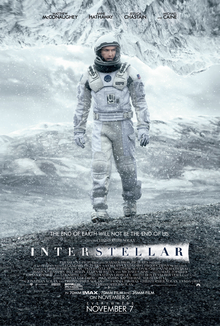
Christopher Nolan's Interstellar arrives not just as a science fiction film, but as a monumental achievement in cinematic ambition. Released in 2014, it represents the culmination of Nolan's fascination with time, space, and human consciousness—a film that dares to ask the biggest questions while delivering spectacle on an unprecedented scale.
The Human Element in Cosmic Scale
What makes Interstellar extraordinary is how it grounds its cosmic ambitions in deeply human concerns. The story follows Cooper (Matthew McConaughey), a former NASA pilot turned farmer, who discovers a mysterious wormhole near Saturn that could save humanity from extinction on a dying Earth. Leaving behind his children, he embarks on a mission to find a new habitable planet.
The film's emotional core lies in Cooper's relationship with his daughter Murph (played as an adult by Jessica Chastain). Their bond transcends time and space, becoming the film's beating heart amidst the scientific complexity. It's a reminder that even in the vastness of the universe, human connections remain our most precious resource.
Scientific Rigor Meets Visual Poetry
Nolan collaborated with theoretical physicist Kip Thorne to ensure scientific accuracy, particularly in depicting black holes and wormholes. The film's depiction of Gargantua—a supermassive black hole—is based on real physics, creating visuals that are both scientifically plausible and breathtakingly beautiful.
The practical effects work is extraordinary. The dust storms on Earth, the icy planet of Miller, and the mountainous waves of Edmunds all feel tangible and real. Hans Zimmer's score, with its organ-like swells and ticking clocks, perfectly complements the film's themes of time and destiny.
A Cast That Elevates the Material
McConaughey delivers a career-defining performance as Cooper, showing remarkable range from despairing father to determined explorer. Chastain brings intelligence and emotional depth to Murph, while Michael Caine provides steady wisdom as Professor Brand. Anne Hathaway and Wes Bentley round out the crew with strong supporting work.
The film's exploration of love as a fundamental force of the universe—transcending time and space—gives it philosophical weight. Cooper's journey becomes not just about finding a new home for humanity, but about understanding what it means to be human.
Ambition That Sometimes Overreaches
That said, Interstellar isn't perfect. The third act's resolution can feel rushed, and some of the scientific explanations may overwhelm casual viewers. The film's three-hour runtime demands commitment, though Nolan's pacing keeps it engaging throughout.
Yet these minor flaws don't diminish the film's achievement. Interstellar succeeds where most blockbusters fail: it treats its audience as intelligent beings capable of grappling with complex ideas. It proves that science fiction can be both intellectually rigorous and emotionally resonant.
A Legacy of Wonder
Eleven years after its release, Interstellar remains Nolan's most visually ambitious film and one of the most scientifically accurate science fiction movies ever made. It stands as a testament to cinema's power to inspire awe and contemplation about our place in the universe.
In a film landscape increasingly dominated by franchise entries and reboots, Interstellar reminds us what original, ambitious filmmaking can achieve. It's not just entertainment—it's an invitation to look at the stars and wonder.
You Might Also Enjoy